Crypto Trading Strategies: 7 Approaches and How to Choose
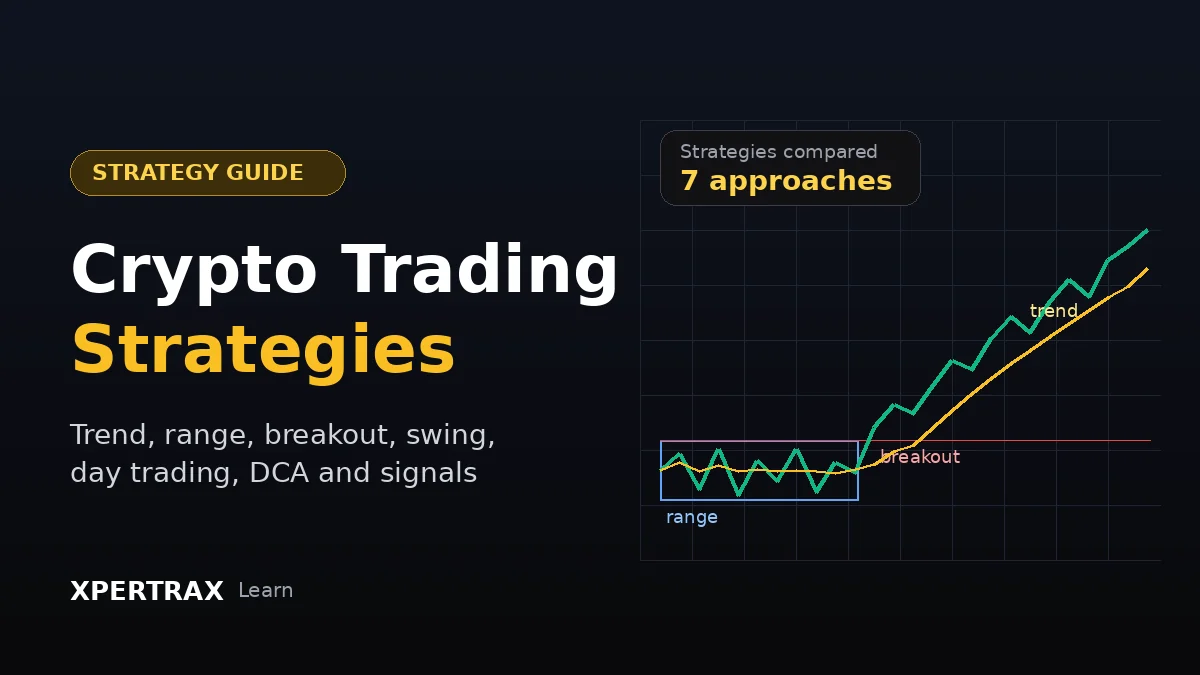
A crypto trading strategy is a written set of rules for when you enter a trade, where you exit, and how much you risk. Without one, every trade is a fresh decision made under pressure. With one, you can measure what works, drop what doesn't, and keep your losses small while you learn.
No strategy wins every trade, and none works in every market. Below are seven common approaches, what each one needs from you, and how to test them before you use real money.
1. Trend following
The idea: trade in the direction the market is already moving. In an uptrend you look for buys; in a downtrend you stay out or go short.
- How traders spot the trend: price above a rising moving average, such as the 50-day or 200-day, or a series of higher highs and higher lows. Our guide to EMA vs SMA in crypto explains which average reacts faster.
- Entry: often on a pullback to the moving average rather than at a new high.
- Exit: when price closes below the average, or with a trailing stop that follows the trend up.
- Weak spot: sideways markets, where the price crosses the average again and again and each signal is a small loss.
2. Range trading
When a coin moves sideways between a floor and a ceiling, range traders buy near the floor and sell near the ceiling.
- Setup: find a support and resistance zone that the price has respected at least twice.
- Entry: near support, ideally with the RSI low and turning up.
- Stop loss: just below support. If the floor breaks, the range is over.
- Weak spot: breakouts. A range ends sooner or later, and the first move out of it is often fast.
3. Breakout trading
Breakout traders wait for that moment: the price leaves a range or pushes through a level that held for a long time.
- Confirmation: a close beyond the level, not just a quick spike, and trading volume clearly above its recent average. See crypto volume analysis.
- Entry: on the close, or on a retest of the broken level from the other side.
- Stop loss: back inside the old range.
- Weak spot: false breakouts, where the price pokes through and falls straight back.
4. Swing trading
Swing traders hold for a few days to a few weeks to catch one move inside a larger trend. It suits people who can check the market once or twice a day rather than all day.
- Tools: daily and 4-hour charts, support and resistance, and momentum indicators such as RSI and MACD.
- Entry: at a level where the risk to the stop loss is small compared with the distance to the target.
- Weak spot: overnight and weekend moves, which you cannot react to while you sleep. Stops must be placed in advance.
5. Day trading and scalping
Day traders open and close positions within the same day; scalpers hold for minutes and take many small gains. Both depend on low fees, fast execution and strict discipline.
- Charts: 1-minute to 15-minute, with volume and short moving averages.
- Costs matter: with many trades a day, fees can take a large share of the profit. Check fees on the best crypto exchanges before you start.
- Weak spot: it takes the most time and the most experience, and leverage makes mistakes expensive. It is the hardest strategy for a beginner.
6. Dollar-cost averaging
Dollar-cost averaging (DCA) is an investment strategy rather than a trading one: you buy a fixed amount at regular intervals, for example every week, whatever the price.
- Why people use it: it removes the need to time the market, and it spreads your entry price over good and bad weeks.
- Who it suits: long-term holders of coins they believe in, who do not want to watch charts.
- Weak spot: it does not protect you from a long decline in a coin that never recovers. Choose what you buy carefully.
7. Signal-based trading
Instead of finding every setup yourself, you follow signals that give a direction, an entry zone, take profit targets and a stop loss.
- Where to start: XPERTRAX publishes free crypto signals every day at 00:00 UTC, and every signal keeps a public result page.
- What to check: whether the stop loss and position size fit your own risk rules. A signal is someone else's plan; the risk is still yours. Read crypto signals for beginners and how to evaluate signal accuracy.
- Weak spot: blindly copying trades without understanding why they were taken.
How to choose a crypto trading strategy
Pick the strategy that fits your time and temperament, not the one with the most exciting results online.
| Strategy | Time needed | Typical hold | Difficulty |
|---|---|---|---|
| Dollar-cost averaging | Minutes a month | Months to years | Low |
| Signal-based | Minutes a day | Hours to days | Low to medium |
| Trend following | Once a day | Weeks | Medium |
| Swing trading | Once or twice a day | Days to weeks | Medium |
| Range trading | A few times a day | Hours to days | Medium |
| Breakout trading | A few times a day | Hours to days | Medium to high |
| Day trading and scalping | Several hours a day | Minutes to hours | High |
Many beginners start with signals or swing trading, because both leave time to think before each trade.
Stop loss and take profit: the part every strategy shares
Whatever the strategy, the exit rules decide most of the result.
- Set the stop loss where the idea is wrong, not at a random percentage: below support for a long, above resistance for a short.
- Size the position from the stop. If you risk 1% of a 1,000 USDT account and the stop is 5% away, the position is 200 USDT. Our crypto risk management guide walks through the maths.
- Plan the take profit before you enter. Many traders take part of the position at a first target and move the stop to break-even for the rest.
- Aim for a target further away than the stop. With a reward at least twice the risk, you can be wrong more often than right and still come out ahead.
Test a strategy before you use real money
Every strategy above can be practised on virtual money first. Crypto paper trading lets you follow your rules on live prices without risking anything. In TradePilot AI a practice account starts with 10,000 USDT of virtual funds; set your stop loss and take profit on each trade, log at least 30 trades with the same rules, then look at the results:
- the share of winning trades;
- the average win compared with the average loss;
- the largest drop in the balance from its high point.
If the numbers hold up, move to real money with a small amount and the same rules. If they don't, change one rule at a time and test again.
Common mistakes
- Switching strategies after every loss. Losses are part of every strategy; judge it over many trades.
- Moving the stop loss further away when a trade goes against you.
- Too much leverage. At 15x, a move of about 6% against you can liquidate the position.
- Trading without a written plan, so there is nothing to review afterwards.
- Expecting a fixed daily income. No strategy makes the same amount every day, whatever online promises say.
Past results, on paper or with real money, do not guarantee future returns. Trade only with money you can afford to lose.
Read next: swing trading crypto with technical analysis; algorithmic crypto trading.