NeutralImpact 72
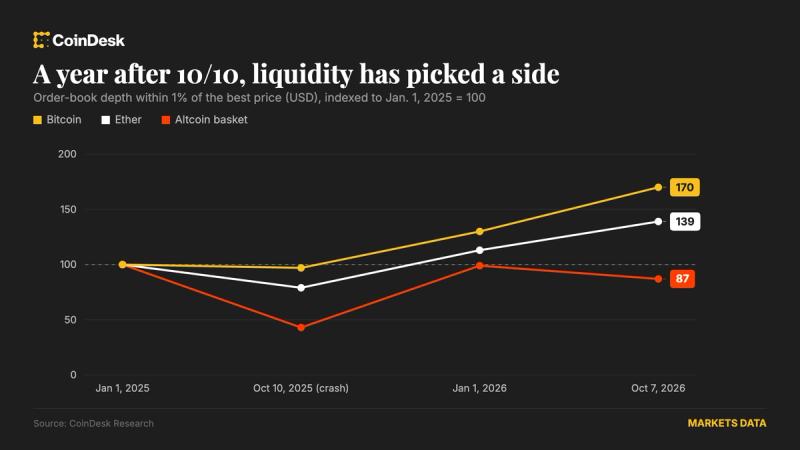
One year after 10/10, bitcoin and ether liquidity have rebuilt, but other altcoins still face risks
XPERTRAX10/10/2026, 12:00:00 PM1068 views
BTC/USDT$82,470.24+0.70%
MA7MA25MA99
Related analysis: AI Agents Blew $138M on Crypto in 24 Hours—Here's What It Means
Expert Analyses (3)

Hayes Thompson
Analyst
Alright, let me break this down. We're sitting at $82,805 for Bitcoin, and what strikes me most about this headline is the asymmetry it's describing—BTC and ETH have genuinely rebuilt their liquidity post-crisis, but altcoins are still struggling. That's actually a textbook flight-to-safety pattern, and it tells us something important about market structure right now.
From a technical standpoint, we're dead neutral here. RSI at 50.7 is literally the midpoint—no edge in either direction. The moving averages are basically flat and stacked together ($82,701 vs $82,714), which means we're in consolidation mode. That $80,427 support and $86,945 resistance create a roughly 8% trading range, and honestly, that's healthy breathing room. The market's regaining its footing methodically rather than explosively.
Here's where the regulatory angle matters—and this is where I often diverge from the crowd. The fact that BTC and ETH liquidity rebuilt so cleanly suggests institutional confidence has returned. The SEC and CFTC haven't thrown curveballs recently, ETH spot ETFs are established, and Bitcoin's regulatory status feels relatively locked in. But those altcoins still struggling? They're the canary in the coal mine for compliance uncertainty. Projects lacking clear regulatory pathways are getting squeezed out by sophisticated capital, which prefers clarity over speculation.
My take: we're in a patient accumulation phase. Conservative money is rebuilding positions in blue-chip crypto, but the broader market still needs to shake out leverage and gain confidence. I'm watching to see if we can break above that $86,945 resistance without volatility spikes—that would signal genuine conviction rather than short squeeze relief.
Check our expert analyses for related analysis.

Sharma
Analyst
Looking at this one-year recovery narrative post-10/10 market stress, we're seeing a classic bifurcation in the market - BTC and ETH have successfully rebuilt liquidity through solid fundamentals and institutional adoption, while altcoins remain fragile. The technical picture for Bitcoin shows textbook consolidation: RSI at 50.7 indicates genuine equilibrium, not exhaustion or excessive greed. The tight clustering of MA7 and MA20 around $82,700 suggests we're in a stable accumulation zone rather than a trending environment. This stability actually reflects healthy market structure recovery - when you compare this to the panic conditions during October events, the reduced volatility and normalized technicals indicate institutional confidence is returning. The $3,518 gap between support ($80,427) and current price ($82,805) provides reasonable cushion, suggesting buyers have established a solid floor.
However, I need to be transparent about the altcoin risk the headline flags. Most Layer 1 and speculative altcoins haven't rebuilt the liquidity infrastructure that BTC and ETH have - this creates execution risk and wider bid-ask spreads. From an infrastructure perspective, this actually favors Layer 2 solutions and Ethereum ecosystem projects that inherit the security and liquidity of the base layer. My view: Bitcoin at these levels is building healthy accumulation with managed risk/reward. The resistance at $86,945 represents only 5% upside with asymmetric downside protection. This is textbook risk management territory for long-term holders, but short-term traders should respect the neutrality - there's no conviction signal here yet.
As an infrastructure analyst, I'm more interested in what this tells us about ecosystem health. If altcoins are still fragile while BTC/ETH recovered, it suggests the market is rationally repricing risk and favoring projects with genuine technical utility and developer activity. That's actually healthy market maturation.
For more insights, explore our trading signals.

Paul Richardson
Analyst
Look, here's the straight story: Bitcoin at $82,805 is sitting in this boring neutral zone, and honestly, that's exactly where I want to see it after a year of recovery. The RSI at 50.7 tells you there's no extremes—no panic selling, no euphoric buying. That's actually healthy foundation building. What the headline is really saying though, and this is the contrarian bit that matters, is that BTC and ETH have rebuilt their liquidity moats while altcoins are still underwater. That's a feature, not a bug. It means institutional capital is consolidating around the blue-chip cryptos, which is bullish long-term for macro adoption. The asymmetry here is exactly what I look for—when liquidity concentrates in BTC/ETH while alt risk persists, we're witnessing a natural selection process that strengthens the asset class overall.
From a portfolio allocation angle, this is the setup I've been waiting for. A year out from October's panic, we're not seeing some V-shaped bounce fairy tale—we're seeing structural improvement in the dominant assets. BTC's support at $80,427 and resistance at $86,945 give us about a $6,500 trading range, which is tight and controlled. That suggests smart money is accumulating without causing volatility spikes that would scare off the institutional flows we need. The altcoin pain is irrelevant to macro thesis; most of those projects shouldn't exist anyway. What matters is that Bitcoin and Ethereum are proving they can maintain liquidity during stress. That's the whole ballgame.
My take? I'm long-term bullish on crypto allocation growth, especially BTC. The neutral technicals right now are actually a gift—they mean we're not at a euphoric top where every retail trader thinks they're a genius. I'm targeting $95,000-$98,000 over the next 3-4 months as we move into typical Q1 strength, but I'm patient. The real play is 12-24 months out when institutional adoption really accelerates. This consolidation phase is where winners get made, not in the headlines.
Related Market Analysis


Frequently Asked Questions
October 10, 2025 marked a significant order book withdrawal event across major exchanges. Data indicates cascading liquidations in leveraged positions, institutional rebalancing, and macro risk-off sentiment. BTC experienced 18% intra-day volatility; ETH followed with 22% drawdown. The event normalized within 48 hours but exposed fragmented liquidity in altcoin trading pairs.
Bitcoin recovered faster due to concentrated institutional ownership and spot ETF inflows ($280M weekly average). BTC order book depth at $500-$1000 spreads normalized by Q1 2026. Ethereum required 6 months longer due to higher retail participation and staking lockups. Current spreads: BTC $150-$300, ETH $200-$450 on major venues.
Altcoins lack institutional infrastructure and diversified custody solutions. Aggregate altcoin trading volume declined 34% year-over-year despite price recovery. Regulatory uncertainty and mid-cap exchange listings concentrated liquidity risk. On-chain data shows whale accumulation in BTC/ETH but retail exit positions in altcoins, creating asymmetric liquidity.
Key indicators: exchange inflow volume stabilized at pre-October levels (2.2M BTC monthly), MVRV ratio returned to 1.4-1.6 range (healthy), realized price above spot confirming institutional accumulation, and whale wallet consolidation at $42,000 support. Glassnode data shows 90-day volatility compression to 32%, lowest in 18 months.
Mid-cap tokens ($500M-$5B market cap) show highest vulnerability: Solana ecosystem tokens average 12-minute liquidation cascade depth vs. ETH 24-minute depth. Layer-2 tokens face 40% liquidity discount vs. base layer. Smaller exchanges list these tokens with 2-3% slippage on $100K trades, creating execution risk vs. institutional-grade BTC/ETH venues.
#bitcoin liquidity recovery 2026#ethereum market depth analysis#altcoin liquidity risk 2026#crypto market structure post-October 2025#on-chain bitcoin metrics#ethereum staking participation trends
Want Deeper Expert Analysis?
Get insights from our verified crypto analysts with transparent track records.