Bitcoin ETF Reality Check: Why Fresh Inflows Are Just Noise
AI Market Impact Summary

Summary
Bitcoin ETF money is flowing back in, but don't mistake the headline for a comeback. The numbers tell a different story entirely.
Bitcoin is hovering near $64,000 this week, and the usual crowd is getting excited about fresh inflows into spot Bitcoin ETFs. It's understandable. After months of watching money leak out like a broken faucet, any positive number feels like vindication.
Here's the problem: it isn't.
The recent inflows are being called a "return to form" by some analysts. That's generous. What we're actually seeing is investors dipping their toes back in after a rough patch—not committing real capital. The volumes are real. The interest is real. The significance? That's where things get fuzzy.
The exodus that preceded these fresh inflows was brutal. We're talking billions in outflows. Now that money is trickling back, but "trickling" is the operative word. Relative to the amount that left, these new inflows are peanuts. And peanuts don't move markets.
What actually matters right now is what's happening behind the noise. Bitcoin needs sustained, serious institutional money to break above current resistance. Not retail traders chasing headlines. Not algorithmic flows triggered by AI startup IPO announcements. Real, committed capital from the kind of players who move the needle.
The Saylor Wildcard
Michael Saylor, Bitcoin's loudest evangelist and arguably its most influential institutional voice, just threw cold water on a blockchain cleanup proposal. He called it "a bad idea." That matters because Saylor doesn't just talk—MicroStrategy's balance sheet gives him real skin in the game.
His pushback suggests the crypto establishment is fracturing on how to approach scaling and utility. When your biggest advocate is warning against what sounds like a technical improvement, it signals deeper disagreements about Bitcoin's future direction. These aren't abstract arguments. They affect whether institutional money keeps flowing or starts looking elsewhere.
Saylor's position also hints at something darker: fear that "improvements" to Bitcoin might centralize control in ways the community doesn't want. That concern isn't paranoid. It's rooted in Bitcoin's entire founding philosophy.
Stablecoins Making Real Moves
While Bitcoin treads water, stablecoins are doing something genuinely interesting. A Japanese logistics company just started using JPYC—a yen-backed stablecoin—to address labor shortages. That's not blockchain theater. That's a real company solving a real problem with crypto infrastructure.
This is the kind of adoption that actually matters. Not flashy. Not sexy. But functional. A business discovered that stablecoins make cross-border labor payments faster and cheaper than traditional banking. So they switched.
Japan's regulatory environment has been relatively clear on stablecoins for months now. That clarity is attracting use cases. While the U.S. is still arguing about stablecoin regulation in committee meetings, Japan's market is moving. That's worth watching.
Derivatives: The Next Act?
Kraken released a paper recently arguing that simpler options could unlock crypto's next derivatives boom. They're probably right, but with a caveat: the market needs to demonstrate it can handle options without blowing itself up first.
Crypto derivatives have a track record of spectacular failures. FTX. Three Arrows Capital. Celsius. The list goes on. Each time, the excuse is the same: "this time we built it differently." And each time, something breaks.
Kraken's argument isn't wrong in theory. Simpler products do reduce complexity and risk. But simplicity also means less leverage, which means smaller returns for speculators. In crypto, that's often a deal-breaker. The market has appetite for options. It doesn't have appetite for boring options.
That tension is unresolved. Until it is, any derivatives expansion will attract both capital and catastrophe in equal measure.
The Regulation Wall
South Korea's regulator just started sanctions against Dunamu, the exchange operator behind Upbit. France is blocking Polymarket ahead of the World Cup final. These aren't outliers. They're the pattern.
Governments are getting comfortable with selective enforcement. They're not banning crypto outright. They're picking targets, applying pressure, and establishing who has authority. That's arguably worse for market confidence than a clear ban would be.
Uncertainty kills institutional adoption faster than hostility. At least with hostility, you know where you stand. With selective enforcement, no one knows which exchange is next or which product gets blocked.
The AI Selloff Hangover
Bitcoin's flat performance this week is partly due to lingering effects from the Kimi AI selloff. Moonshot AI is pushing toward an IPO. Alibaba released new AI models. And somehow, all of this is moving crypto markets.
That correlation is worth questioning. Why should AI startup momentum affect Bitcoin's price? The answer reveals something uncomfortable: Bitcoin is being treated as a risk-on asset alongside high-growth tech stocks. Not as a hedge. Not as digital gold. As a speculative play.
That positioning is fragile. When AI hype retreats—and it will—Bitcoin gets pulled down with it. That's not what Bitcoin advocates promised. It's not what institutional buyers signed up for either.
Where This Actually Goes
Bitcoin at $64,000 is consolidation, not capitulation. The ETF inflows matter less than the inflows-to-outflows ratio, which is still negative on a longer timeframe. Real money isn't convinced yet.
The interesting action is happening in stablecoins and specific use cases. Japan's JPYC adoption is more significant for crypto's future than Bitcoin hitting any specific price target. That's counterintuitive. But it's also true.
What Bitcoin needs now is either a catalyst powerful enough to override current regulatory uncertainty, or a sustained period of boring sideways price action while institutional infrastructure builds quietly. The flashy rallies based on AI hype don't qualify.
Fresh ETF inflows are nice. But they're not the story. The story is whether institutional money sees value at $64,000, or whether it's waiting for clearer signals about regulation, use cases, and Bitcoin's actual role in a portfolio.
The peanuts have arrived. The real money is still watching.
Discover more in our trading guides.For additional context on BTC market developments, explore our related market analysis.
Expert Analyses (3)

Lisa Anderson
Analyst

Carlos Mendez
Analyst

Marcus Weber
Analyst
Related Market Analysis
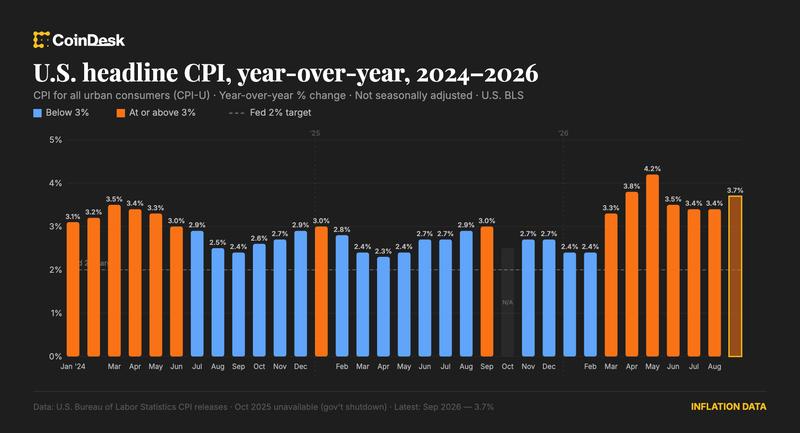
U.S. September CPI comes in hot, sending bitcoin sharply lower

Kraken parent to buy Lithuanian Saldo Bank amid TradFi expansion

Morning Minute: Move Over, Saylor, There’s a New Top Buyer in Town

Evernorth taps Ripple, Kraken, Coinbase and BitGo to put $648 million XRP treasury to work
Related Questions
Frequently Asked Questions
Want Deeper Expert Analysis?
Get insights from our verified crypto analysts with transparent track records.