Market TalkMarcus Weber27d ago
SEC Discusses 24-Hour Stock Trading — Is Wall Street Becoming More Like Crypto?
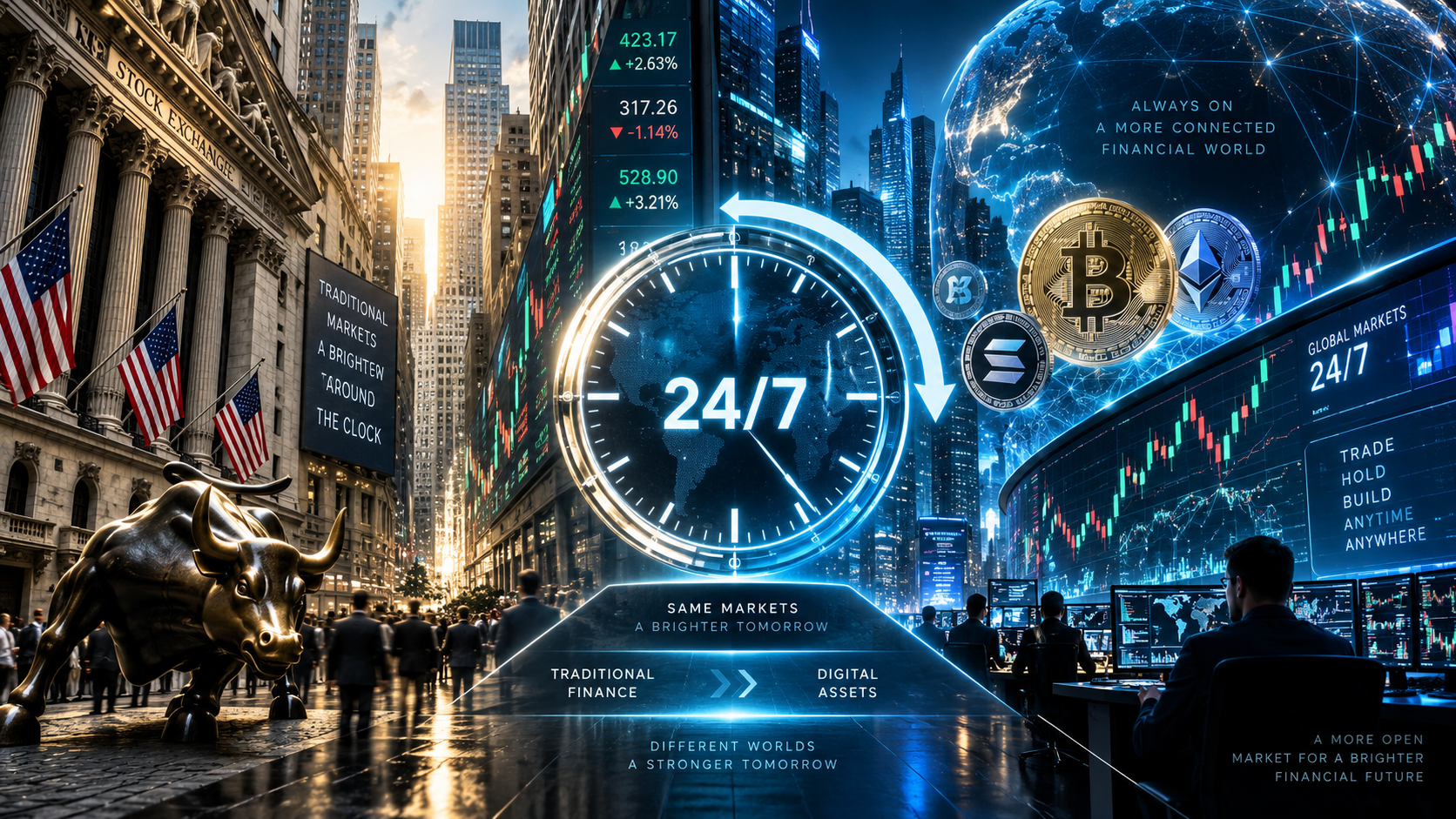
One of cryptocurrency's most recognizable features has always been simple:
The market never closes.
Bitcoin can trade at 3 a.m. on Sunday.
Ethereum can move during Christmas.
A meme coin can suddenly rally while Wall Street is asleep.
But traditional financial markets are now moving closer toward the same model.
On September 17, 2026, the U.S. Securities and Exchange Commission is holding a major public roundtable focused on preparations for 24-hour stock trading in the United States.
And some of the biggest names in finance are participating.
Representatives from NYSE, Robinhood, BlackRock, Cboe, UBS, BNY Pershing, Virtu Financial, Jane Street, State Street and FINRA are among the scheduled participants.
This could have major implications for the future relationship between traditional finance and crypto.
Why Is the SEC Discussing 24-Hour Trading?
The traditional U.S. stock market operates around defined trading sessions.
Crypto does not.
That difference has become increasingly noticeable as global investors expect faster access to markets regardless of their location or timezone.
The SEC announced its roundtable specifically to examine preparations for moving toward a 24-hour market, including overnight trading, market resilience and investor protection.
SEC Chairman Paul Atkins described U.S. equities as moving toward a market that operates during both the day and night while emphasizing the need to preserve investor protections.
Importantly, the event itself does not mean U.S. stocks automatically become 24/7 immediately.
It is a discussion about market readiness, risks and potential next steps.
What Does Wall Street Need Before Stocks Can Trade Around the Clock?
Running a market nearly continuously is much more complicated than simply leaving an exchange open overnight.
According to the SEC's agenda, regulators and firms are examining issues including:
* Overnight market surveillance
* Clearing and settlement
* Liquidity
* Cybersecurity
* Market-data continuity
* System failures and backup infrastructure
* Staffing requirements
* Closing-price calculations
* Investor protection
Liquidity is particularly important.
A market may technically be open, but that doesn't guarantee large numbers of buyers and sellers will be available at 2 a.m.
Thin overnight liquidity can create larger spreads and stronger price movements from relatively small orders.
Crypto traders already understand this phenomenon well.
Crypto Has Been 24/7 From the Beginning
The comparison between crypto vs stocks is becoming increasingly interesting.
Crypto markets operate continuously because digital assets were built around global blockchain infrastructure rather than traditional exchange schedules.
There is no traditional closing bell for Bitcoin.
That has provided crypto traders with both advantages and disadvantages.
The advantage is accessibility.
The disadvantage is that risk never sleeps either.
A major announcement, liquidation event or geopolitical shock can move crypto prices instantly, regardless of the hour.
If U.S. equities continue toward 24/7 trading, traditional investors may eventually experience more of the same dynamics.
Robinhood, NYSE and BlackRock Are at the Table
The list of participants is important.
Robinhood has already helped popularize extended-hours trading among retail investors.
NYSE represents one of the core institutions of U.S. equity-market infrastructure.
BlackRock is the world's largest asset manager and has also become an important participant in digital assets through cryptocurrency investment products.
Their participation demonstrates that the discussion around SEC 24-hour trading involves institutions across the financial ecosystem rather than just one trading platform.
Could 24-Hour Stocks Reduce Crypto's Advantage?
Crypto has historically marketed itself partly around accessibility:
Open markets.
Global participation.
Instant transfers.
No weekends.
If traditional markets extend toward near-continuous trading, one of those distinctions becomes smaller.
But that does not make crypto and equities identical.
A publicly traded stock represents ownership in a company.
Bitcoin is a decentralized digital asset.
Tokenized assets, stablecoins and blockchain-based settlement add yet another layer.
The more significant development may therefore be convergence.
Traditional finance is adopting some characteristics familiar to crypto users, while crypto markets are increasingly adopting institutional infrastructure familiar to Wall Street.
Tokenization Could Make This Even More Interesting
The movement toward longer trading hours also overlaps with another major financial trend: tokenization.
If stocks, bonds and funds increasingly become available through blockchain-based infrastructure, investors may eventually expect traditional assets to behave more like digital assets:
Available globally.
Tradeable for longer periods.
Transferred more quickly.
Settled with fewer delays.
That future is not guaranteed, and significant regulatory and technological questions remain.
But 24-hour stock trading is one indication of where market expectations are heading.
The Risks of Never-Ending Markets
Continuous access sounds attractive.
But it creates trade-offs.
Investors may feel pressure to monitor markets constantly.
Liquidity may be uneven across different hours.
Financial institutions need systems that can operate with much shorter maintenance windows.
Cybersecurity teams need constant coverage.
Regulators must monitor markets overnight.
The SEC's agenda specifically includes these operational and resilience concerns.
So the discussion is not simply about allowing traders to buy stocks at midnight.
It is about rebuilding parts of the financial-market infrastructure around a longer operating day.
Final Take
For crypto investors, the significance goes beyond stocks.
For more than a decade, 24/7 trading has been one of the features distinguishing cryptocurrency from traditional financial markets.
Now Wall Street is moving closer to that model.
The SEC's September 17 roundtable does not guarantee immediate round-the-clock U.S. equity trading, but it demonstrates that regulators and major financial institutions are actively preparing for a market with far longer trading hours.
The bigger question may eventually become:
If stocks can trade almost around the clock, assets become tokenized and settlement gets faster, where exactly does traditional finance end and crypto infrastructure begin?
That could become one of the most important financial-market stories of the next few years.
#SEC #24HourTrading #Crypto #NYSE #Robinhood #BlackRock #Bitcoin #WallStreet #Tokenization
05