Market TalkMarcus Weber26d ago
🚨 SEC Opens the Door to Tokenized U.S. Stocks — Is Wall Street Moving Onchain?
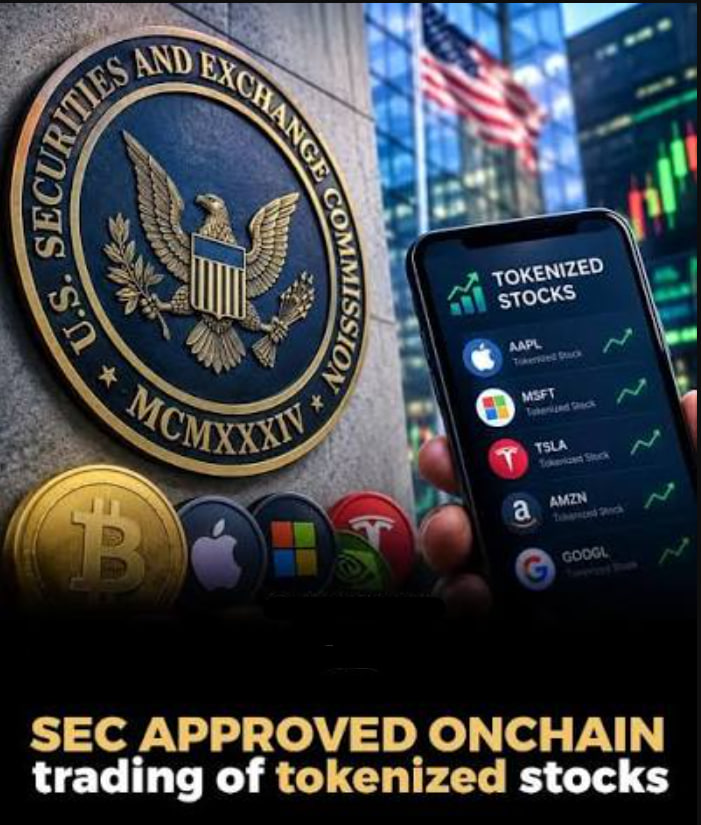
Wall Street just moved another step closer to blockchain.
On September 17, the U.S. Securities and Exchange Commission introduced a temporary Innovation Exemption designed to allow certain platforms to facilitate onchain trading of tokenized U.S. stocks.
The exemption will run for five years and creates a controlled framework for what the SEC calls Tokenized Securities Venues, or TSVs.
For the crypto industry, this could become one of the most important developments in the convergence between traditional finance and blockchain.
What Are Tokenized Stocks?
A tokenized stock is a blockchain-based representation of a traditional equity.
But the SEC's framework makes an important distinction.
Eligible tokenized stocks must provide holders with the same economic and ownership rights as the underlying traditional shares.
That can include:
• Dividend rights
• Voting rights
• Ownership privileges
• Economic exposure to the actual security
Synthetic tokens that merely track a stock's price without providing equivalent shareholder rights are treated differently.
Under the exemption, issuers must also be given an opportunity to object before an unaffiliated third party makes a tokenized version of their stock available.
Why Is the SEC Doing This?
Traditional securities markets depend on multiple layers of infrastructure.
Trading venues, brokers, clearing systems, custodians and settlement networks all play a role.
Blockchain potentially allows some of these processes to become more integrated.
SEC Commissioner Mark Uyeda said tokenization could help modernize areas including trading, settlement, transfer and ownership records while potentially lowering costs and improving transparency.
That doesn't mean the existing financial system disappears.
Instead, regulators are essentially allowing controlled experimentation with a different market structure.
Automated Market Makers Are Entering Traditional Finance
One particularly interesting part of the exemption is the use of permissioned automated market maker liquidity pools.
Crypto users already know AMMs from decentralized exchanges.
Instead of traditional buyers and sellers constantly placing orders against each other, liquidity is supplied to pools and trading happens according to the venue's pricing mechanisms.
Bringing a version of that model into regulated securities markets represents a major crossover between DeFi infrastructure and Wall Street.
However, these venues will operate under restrictions.
The SEC says participating platforms must meet requirements involving transparency, transaction records, technology safeguards and market monitoring. There are also limits on trading volume and the number of securities available.
Could Tokenized Stocks Trade 24 Hours?
This is where the story becomes even more interesting.
The SEC is simultaneously examining longer trading hours for U.S. markets.
Blockchain infrastructure naturally supports markets that operate outside traditional exchange hours.
Crypto already trades around the clock.
If tokenized securities expand alongside longer trading sessions, the distinction between crypto-market infrastructure and traditional-market infrastructure could gradually become smaller.
That doesn't mean NYSE stocks suddenly become 24/7 tomorrow.
But the direction is becoming clearer:
Traditional finance is exploring infrastructure that crypto users have been using for years.
Why This Matters for Crypto
Tokenization could become much larger than simply putting stocks on blockchains.
The same infrastructure could eventually support:
• Stocks
• Bonds
• Treasury securities
• Funds
• Private-market assets
• Real estate interests
• Other financial instruments
That creates potential opportunities for blockchains, stablecoins, custody providers and other companies providing the infrastructure underneath these markets.
The larger crypto narrative could therefore shift from:
“Crypto replacing traditional finance.”
to:
“Traditional finance gradually adopting blockchain infrastructure.”
The Five-Year Experiment
The exemption is temporary.
It runs from September 17, 2026 through September 17, 2031, unless the SEC changes the framework earlier.
During that period, regulators will collect data and determine whether longer-term rules are appropriate.
That makes this less of a final regulatory decision and more of a large-scale experiment.
But experiments can become permanent infrastructure.
Exchange-traded funds themselves developed through earlier uses of regulatory exemptions before becoming mainstream investment products.
Final Take
The biggest takeaway isn't simply that investors may eventually trade Apple or Nvidia shares on a blockchain.
It's that onchain trading is moving closer to regulated mainstream finance.
Crypto spent years proving that assets could trade continuously through programmable infrastructure.
Now Wall Street is beginning to test similar concepts.
The next battle may not be crypto versus traditional finance.
It may be about which blockchains and financial companies provide the infrastructure when the two finally meet.
#Tokenization #Crypto #SEC #Blockchain #TokenizedStocks #DeFi #WallStreet #Web3
05